

Adaptive Swelling in Injection Resins – Durable Waterproofing with HydroBloc Integral 575

Durable Waterproofing with HydroBloc® Integral 575

Waterproofing Means More Than Simply Filling a Crack

A successful crack injection is often judged by whether water ingress stops immediately after the work has been completed. However, structural waterproofing must not only work at the moment of injection. It must continue to perform even if conditions within the building component change at a later stage.

Concrete structures are never completely static. Temperature fluctuations, changes in load, shrinkage, settlement or vibrations can cause cracks and joints to move slightly. At the same time, water exposure can change: a crack may be dry today but carry water again during heavy rainfall or when the groundwater level rises.

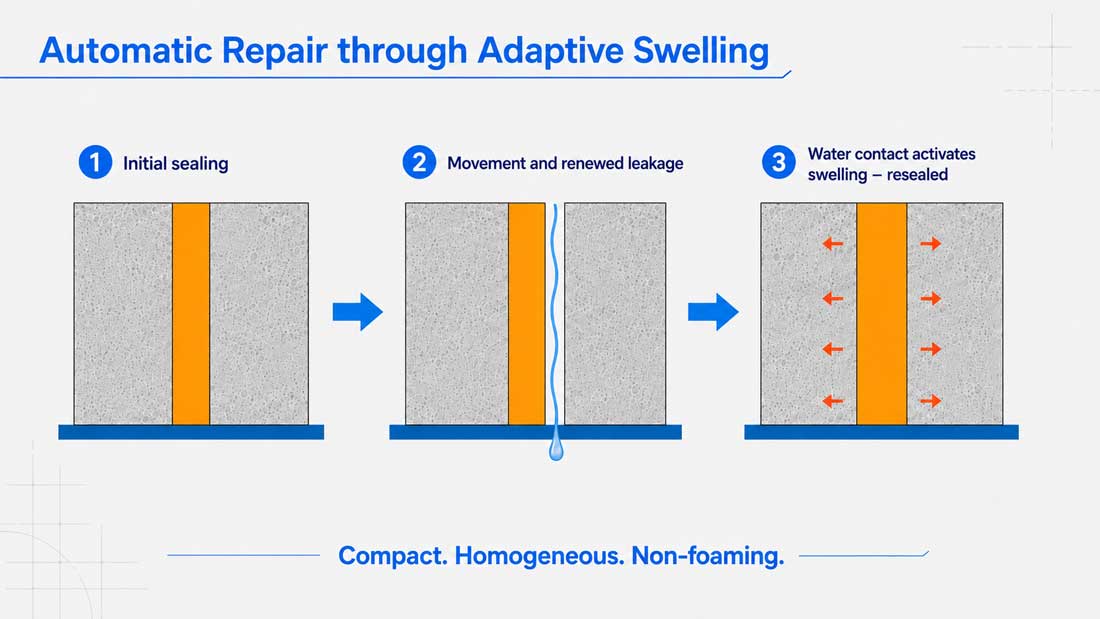
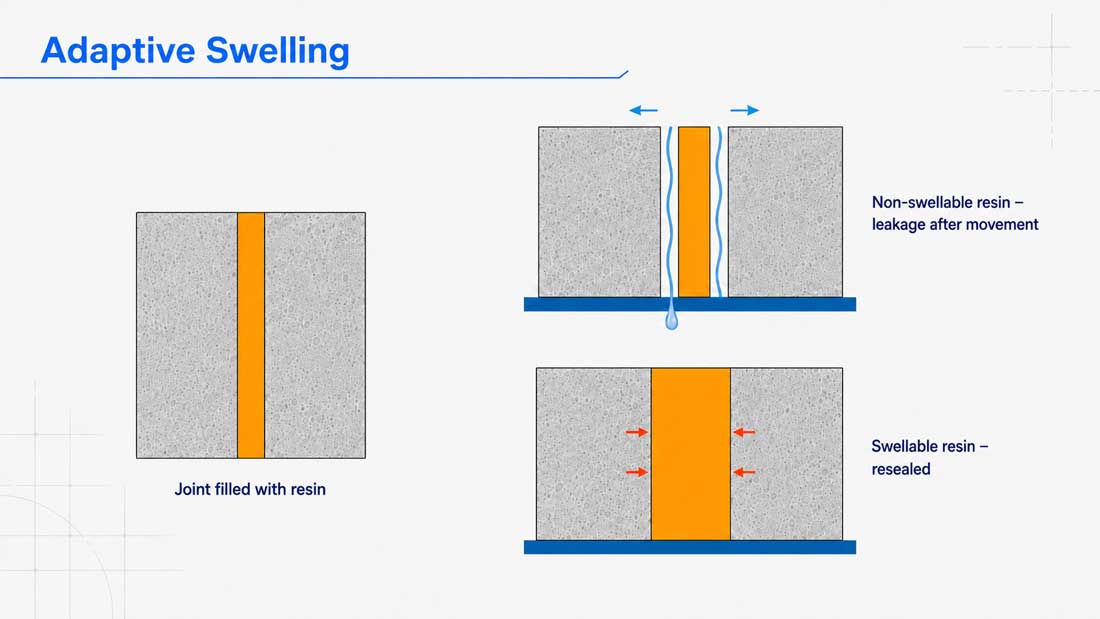
This is precisely where adaptive swelling comes into play. An adaptively swellable injection resin does not remain passive after curing. If it comes into contact with water again, it increases its volume in a controlled manner and can thereby reseal newly formed, small water paths.

This is neither a magical effect nor unlimited “self-healing”. It is the result of purposefully engineered material chemistry.
What Is Adaptive Swelling?

“Adaptive” means that a material can respond to changing environmental conditions. In an adaptively swellable injection resin, water is the triggering factor.

The process can be simplified into four steps:

  1. The liquid resin is injected into a crack, joint or void.
  2. It reacts and forms a homogeneous, elastic injection body.
  3. If the fully cured material comes into contact with water again at a later stage, its volume increases in a controlled manner.
  4. When the moisture level decreases again, the swelling recedes towards the original cured volume.

This process is reversible and repeatable. When exposed to water again, the material can swell again. It therefore does not react only once during curing but remains water-active throughout its service life.
Why Is This Property So Important for Structural Waterproofing?

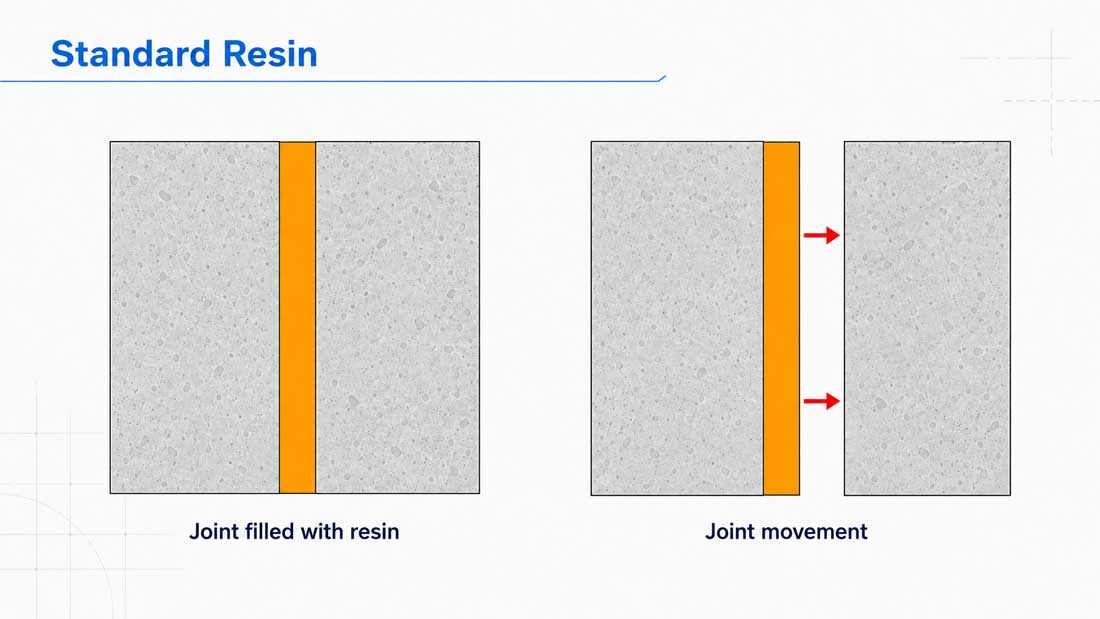
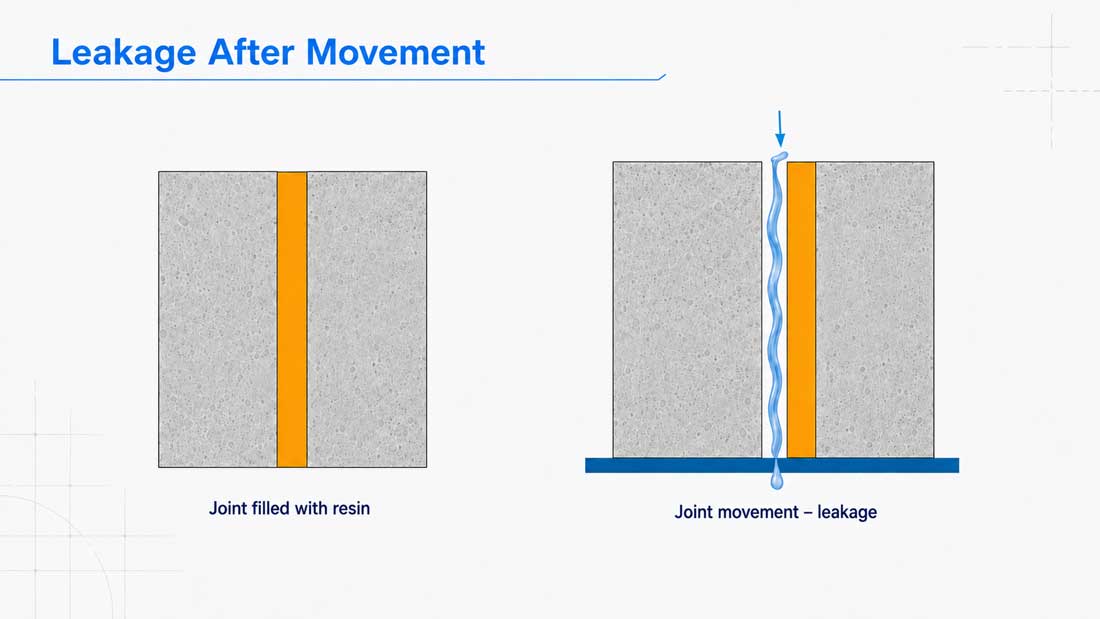
A conventional rigid injection resin may initially fill a crack completely. However, if the structural component subsequently moves, new, fine separations may form between the resin and the crack faces. Renewed cracking can also occur within an injection body that is too rigid.

Elastic resins can accommodate movement more effectively. Their elongation capacity, however, is not unlimited. If the crack cross-section changes or a small new water path forms, elasticity alone may not always be sufficient to restore or maintain a watertight seal permanently.

Adaptive swelling complements elasticity with an active response: if water penetrates a newly formed imperfection, it activates the material’s swelling capacity. The injection body locally increases in volume and exerts controlled contact pressure against the surrounding surfaces. This can reseal small water-bearing paths.

The material therefore reacts exactly where water is present—and exactly when this response is needed.


Swelling Is Not Foaming

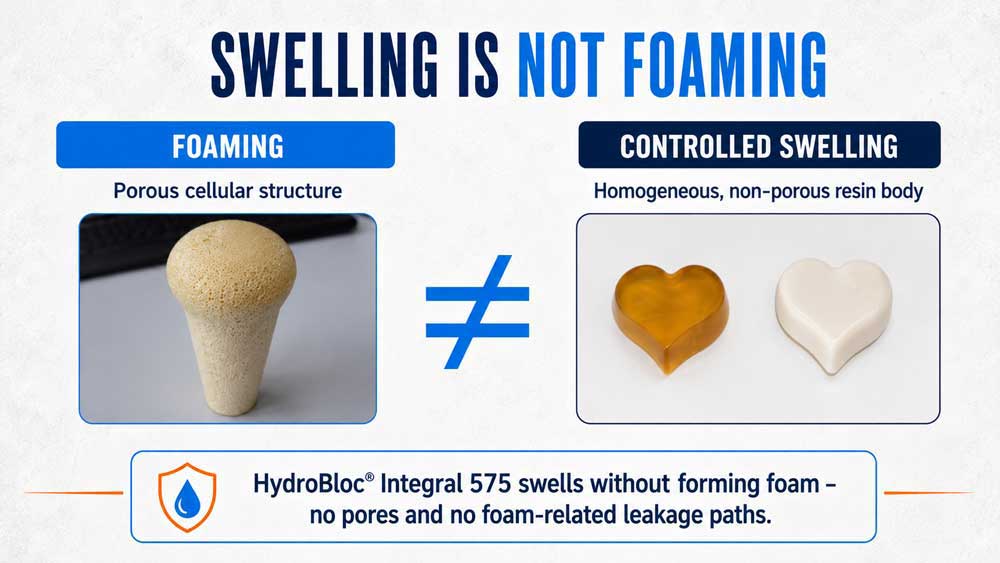
The terms “swelling” and “foaming” are frequently confused in practice. Technically, however, they describe two fundamentally different processes.
EN-Hydrophilic-no-foam

Foaming

During foaming, gas is generated as part of the chemical reaction. This gas forms cells and pores within the material. The volume increases considerably, while a more or less open- or closed-cell foam structure develops.

PU foams are particularly valuable for stopping water quickly. Their expansion, however, occurs primarily during the reaction and curing process. Once the foam has fully cured, this initial expansion process cannot be repeated.

Swelling

Swelling does not generate gas or create a foam structure. Upon contact with water, the already cured material increases its volume in a controlled manner. It remains homogeneous and non-porous throughout the process.

This distinction is relevant to durability:

  • Foam has a cellular structure.
  • A swellable injection body remains homogeneous.
  • Foaming is primarily a process that occurs during the reaction.
  • Adaptive swelling is reactivated by subsequent contact with water.
  • The swelling process is reversible and repeatable.

We offer several adaptively swellable injection resins. Here, we explain the effect using the one-component resin HydroBloc® Integral 575 as an example.

HydroBloc® Integral 575 does not foam upon contact with water. Once cured, it forms an elastic, homogeneous and non-porous resin body that can swell in a controlled manner when it comes into contact with water again.
EN-Reversible-letztes-Bild

Up to 120% Swelling After Curing

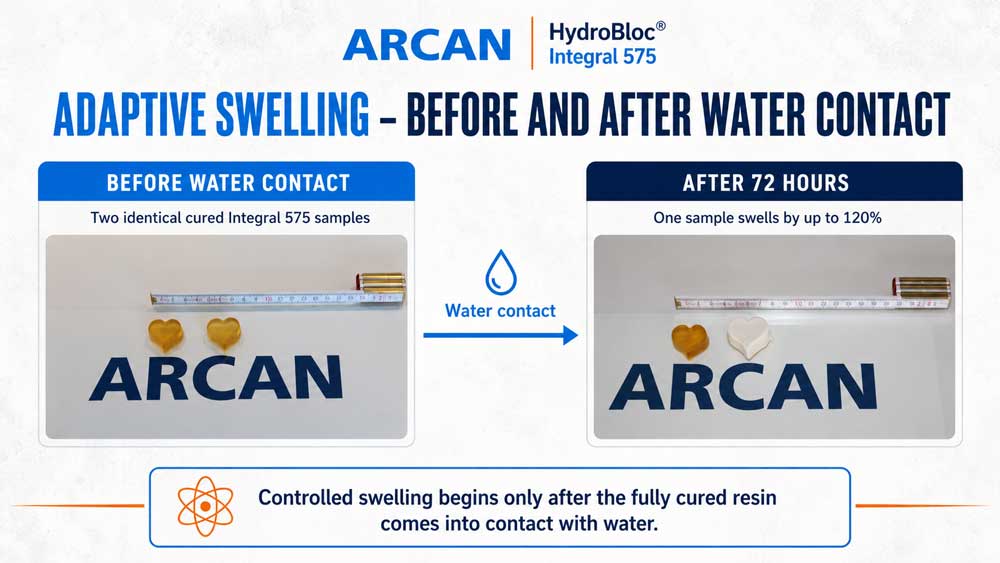
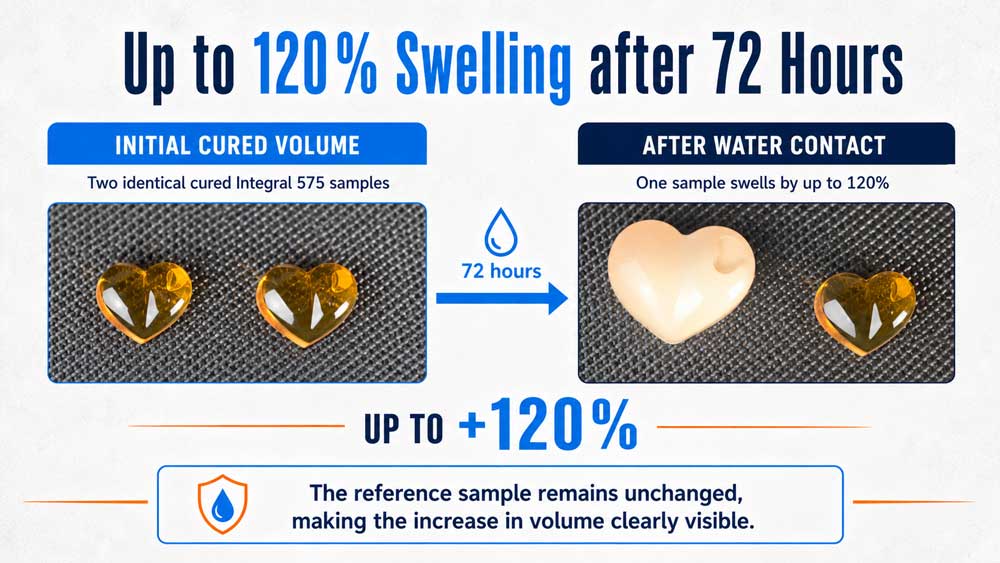
HydroBloc® Integral 575 can increase in volume by up to 120% after 72 hours of contact with water. The timing is crucial: swelling occurs in the material only after it has fully cured.

This effect can be clearly demonstrated in comparative tests. Two identical, cured samples initially have the same volume. One sample is then exposed to water, while the other remains unchanged as a reference. After 72 hours, the water-exposed sample shows a significant increase in volume without forming a porous foam structure.

The figure “up to 120%” does not describe uncontrolled expansion. The swelling that can actually be achieved depends, among other factors, on water availability, temperature, the geometry of the injection space and the surrounding resistance. Within the structural component, the crack faces limit free volume expansion. This enables the material to develop controlled contact pressure within the area being sealed.
EN-Reversible-bild-2

Reversible—but Never Smaller Than the Original Volume

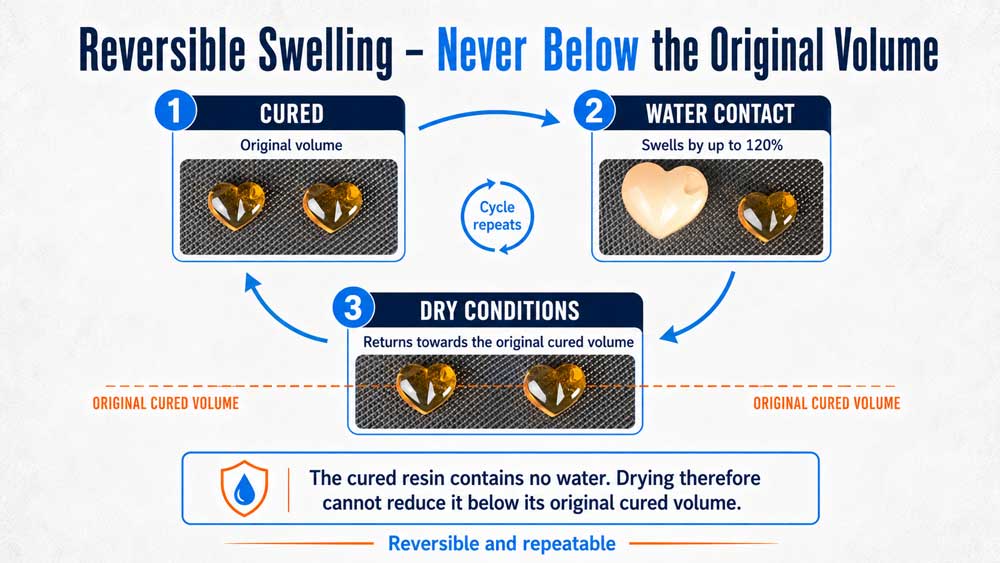
When water exposure decreases, the swelling also subsides. The material returns towards its original cured volume. This process is reversible: when it comes into contact with water again, the resin can swell again.

One important point must be noted: the cured resin itself contains no water. The additional swelling triggered by contact with water can subside during drying, but the material does not shrink below its original cured volume. This is the essential difference compared with gels: gels contain water and can shrink below their initial level under dry conditions. For this reason, gels are not recommended for joints or cracks that are not permanently moist.

In simple terms:

  • The starting point is the fully cured injection body.
  • Contact with water activates the additional increase in volume.
  • During drying, the material returns towards its original volume.
  • It does not fall below its original cured volume.
  • When contact with water occurs again, the swelling process begins again.

This repeatability distinguishes adaptively swellable resins from materials whose expansion occurs exclusively during a single chemical reaction.

The Self-Healing Effect—a Helpful Term That Requires Explanation

Adaptive swelling is often referred to as a “self-healing effect”. The term illustrates how the process works, but it should be interpreted correctly from a technical perspective.

The self-healing effect relates exclusively to the waterproofing function: if minor movements create new water-bearing paths, the ingress of water can reactivate the swelling process. The material increases its volume, thereby helping to reseal these fine paths.

A more precise term would therefore be a “water-activated, reversible resealing effect”.

Conclusion: Waterproofing That Can Respond to Water

Adaptive swelling adds an active, water-dependent function to conventional elastic crack sealing. The cured resin remains homogeneous and non-porous. When it comes into contact with water again, its volume increases in a controlled manner, enabling it to reseal small, newly formed water paths.

The swelling process is reversible and repeatable. During drying, the material returns towards its original cured volume without falling below it. The waterproofing system therefore responds not only during application but also to changing moisture conditions within the structure at a later stage.

HydroBloc® Integral 575 combines this adaptive swelling effect with a non-foaming, elastic, one-component PU injection resin. This makes it a versatile solution for cracks, construction joints, honeycombs, injection hoses and many other common waterproofing tasks.

Adaptive Swelling Explained in Our Video

Our video explains what adaptive swelling means and why adaptive, swellable resins represent an important advance in reliable structural waterproofing:

Why These Resins Are Essential for Reliable Waterproofing—Watch the Video

Would You Like to Know Whether an Adaptively Swellable Resin Is Suitable for Your Project?

ARCAN can support you in assessing the cause of the damage, selecting the appropriate injection material and developing a project-specific waterproofing concept. Send us information about the structural component, the type of leakage, the existing water exposure and any potential movement.

Together, we will develop a technically appropriate and permanently effective solution.

Further information: www.arcan.biz


HydroBloc Integral 575 – 1C Non-Foaming PU Injection Resin

Triumph des Integral 575 Läufers

Why Choosing the Right Injection Resin Matters

Cracks in concrete, leaking construction joints, water-bearing honeycombs or injection hoses that need to be injected: water ingress can have many different causes. The range of available injection materials is correspondingly broad. In practice, this often raises one crucial question: which resin is right for the job?

Understandably, many applicators rely on the product they already know. While this may initially provide a sense of security, it is not always the best technical or economical solution. A resin that reacts too quickly limits penetration depth, as does a resin that exhibits side reactions such as foaming upon contact with water. Foam resins stop water temporarily, but their porous structure means that they do not provide a permanently watertight seal. Even an elastic resin can accommodate movement only within the limits of its specific properties.

HydroBloc® Integral 575 was developed as a versatile injection resin for the majority of typical waterproofing tasks. It combines simple application with moisture-adaptive reaction behaviour and a permanently elastic, swellable structure. As a result, one product can be used for up to 80% of common waterproofing applications.

What Is HydroBloc® Integral 575?

HydroBloc® Integral 575 is a ready-to-use, one-component, hydrophilic polyurethane injection resin. It reacts with moisture but does not form a foam. Instead of producing a porous foam structure, it cures to form a homogeneous, elastic and non-porous material.

The resin is particularly suitable for:

  • crack injection
  • construction joints
  • honeycombs and voids
  • injection hoses
  • stopping water ingress

Its key strength does not lie in one single property, but in the interaction of several functions. HydroBloc® Integral 575 adapts its reaction to the available moisture, penetrates deeply into cracks and voids under suitable conditions, and can respond to water again after curing. This is the principle of DPI – Deep Penetrating Injection – which seals the entire path from the point of injection to the point of water ingress.

Hydrophilic – but Non-Foaming

Water-reactive polyurethane resins are often automatically associated with PU foam. HydroBloc® Integral 575 works differently. Although the resin is hydrophilic and therefore has a strong affinity for water, it does not foam during the reaction.

This distinction is crucial to the quality of the waterproofing result. Foams consist of numerous cells and pores. They are especially useful for rapidly stopping water, but they do not provide the same homogeneous structure as a compact injection material in every application.

After reacting, Integral 575 forms a uniform, elastic mass. Voids are not merely filled with foam; they are sealed with a homogeneous material. This provides a compact and durable waterproofing solution.

EN-Hydrophilic-no-foam

Adaptive Reaction Behaviour: A Resin That Responds to Site Conditions

Moisture is rarely distributed evenly throughout a structure. One section of a crack may be carrying running water, while another section only a few centimetres away is merely damp. Conventional resins often react at almost the same speed under both conditions.

HydroBloc® Integral 575, however, has an adaptive reaction profile:

  • In contact with larger amounts of water, the resin reacts more quickly.
  • Where less moisture is present, it reacts more slowly.

As moisture is always present within the structure, reliable reaction of the resin is guaranteed.

The reaction therefore adapts to the actual conditions within the structure. This is particularly beneficial in components with uneven moisture distribution: where more water is present, the resin reacts more quickly; where less moisture is present, it reacts more slowly.

Reversible Swelling of up to 120%: Waterproofing That Can Adapt

Concrete structures are not completely static systems. Temperature fluctuations, settlement, load changes and other influences can cause minor movement. Even a successfully injected crack may therefore change slightly over time and lead to renewed leakage.

After curing, HydroBloc® Integral 575 remains elastic and can increase its volume by up to 120% when it comes into renewed contact with water. This swelling process is reversible: when the moisture level decreases, the material contracts again. If water returns at a later stage, the resin can react and swell again.

This property helps the waterproofing system respond to minor subsequent changes in the crack or void structure. The resin therefore does more than react during the initial injection; it retains an adaptive function after curing.


EN-Reversible-bild-2
EN-Reversible-letztes-Bild

Typical Applications for HydroBloc® Integral 575

Crack Injection

Cracks can form pathways for water through concrete structures and may eventually affect the reinforcement and the serviceability of the structure. Integral 575 spreads throughout the crack, reacts with the available moisture and cures to form an elastic, homogeneous injection body.

Sealing Construction Joints

Construction joints are among the typical weak points in water-exposed concrete structures. Defects or inadequately sealed areas can be treated by targeted injection. The adaptive reaction behaviour is particularly useful because moisture may be distributed unevenly within the joint.

Injecting Honeycombs

Honeycombs occur when concrete is not fully compacted during placement or when its components segregate. Voids remain between the coarse aggregates and can allow water to penetrate the structure. HydroBloc® Integral 575 can spread through these voids and seal them permanently and elastically without forming a disruptive foam structure that could lead to renewed leakage over time.

Injection of Injection Hoses

Integral 575 is also suitable for injecting compatible injection hose systems. The one-component resin simplifies application because two components do not need to be mixed in the correct ratio on site. The fact that Integral 575 does not produce unwanted side reactions such as foaming makes it an ideal material for injecting injection hoses.

Stopping Water without Foam

Where water is entering the structure, the available moisture accelerates the reaction. Integral 575 can therefore also be used to stop water directly, without forming the porous structure typical of conventional PU foams. The second injection with a compact material normally recommended after a foam injection is not necessary when Integral 575 is used, because the cured material is already homogeneous.

One-Component and Ready to Use

In addition to its technical properties, practical handling is an important consideration. HydroBloc® Integral 575 is supplied as a ready-to-use, one-component resin. This eliminates the risk of errors when mixing A and B components. Remaining material can also be managed more efficiently because it does not necessarily have to be used immediately.

For applicators and specialist contractors, this offers several advantages:

  • fewer products for different standard applications
  • simpler stock management and site logistics
  • no two-component mixing ratio
  • no possibility of mixing errors
  • flexible use under changing moisture conditions

However, a versatile resin does not replace a professional assessment. The type and width of the crack, water flow, component temperature, accessibility and objective of the injection must be evaluated before every application.

What Are the Application Limits?

“For 80% of waterproofing applications” does not mean that one resin can solve every problem. Special applications still require systems specifically designed for their purpose.

HydroBloc® Integral 575 is not the preferred solution for applications such as:

  • expansion and movement joints subject to substantial designed movement
  • curtain injection behind the structure
  • horizontal barriers against rising damp

Other injection materials and methods are available for these applications, including fast-reacting injection rubber, acrylate gels and dedicated horizontal damp-proofing systems. The correct product selection must always be based on the cause of the water ingress and the physical conditions of the structure.

Conclusion: Versatility Backed by Technical Performance

HydroBloc® Integral 575 covers a large proportion of everyday structural waterproofing tasks with a single product. The hydrophilic, non-foaming, one-component PU resin combines adaptive reaction behaviour with a homogeneous, permanently elastic structure and reversible swelling of up to 120%.

For specialist contractors, this means fewer product changes, simpler stock management and greater flexibility under varying site conditions. A professional assessment of the damage nevertheless remains essential. Successful and durable injection does not begin with the pump; it begins with the correct diagnosis and the right choice of material.

Unsure Which Product Is Right for Your Application?

ARCAN can support you in assessing your waterproofing task and selecting the appropriate injection system. Send us information about the structure, the type of leakage and the level of water exposure. Together, we will develop a technically suitable solution.

Further information: www.arcan.biz | office@arcan.biz