


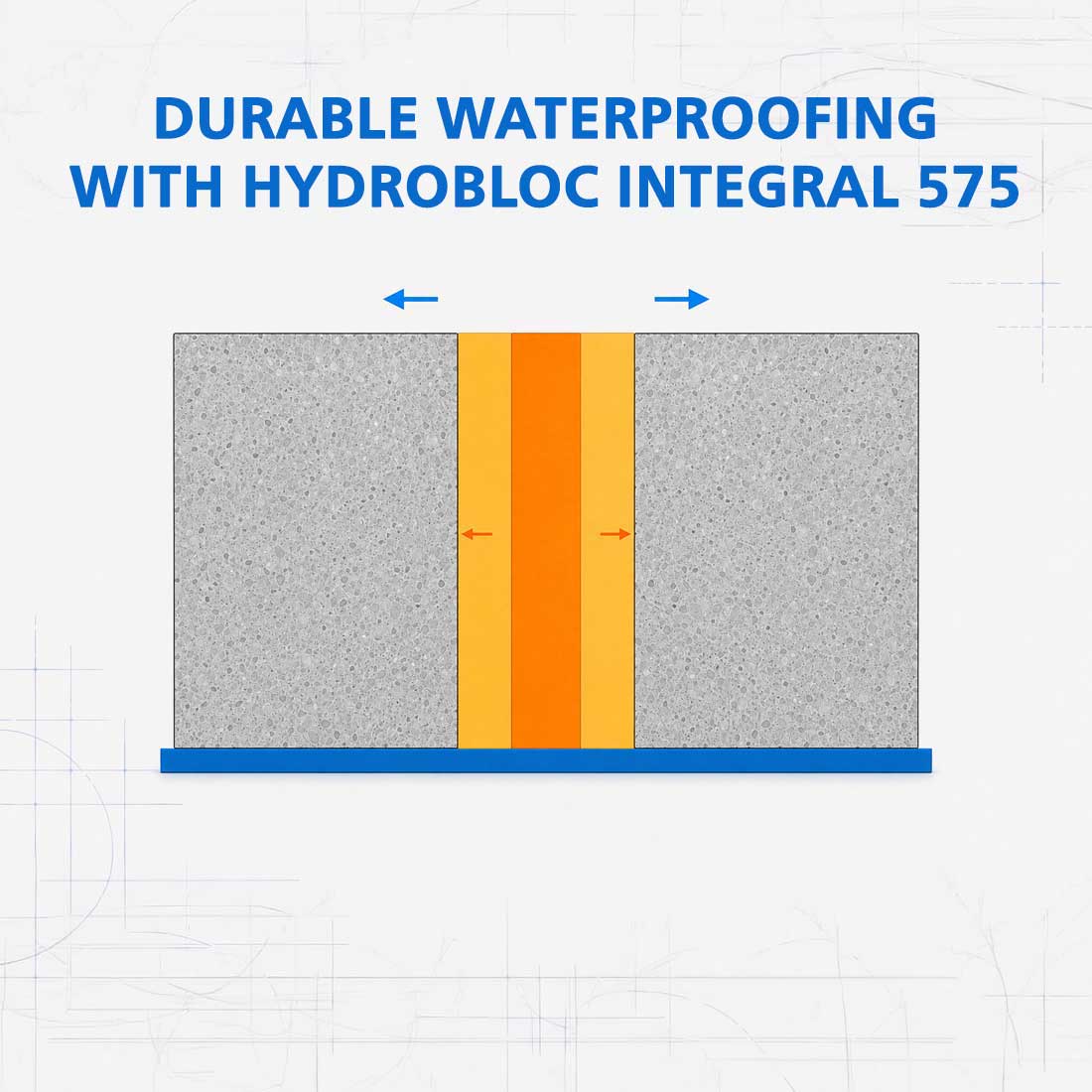
Waterproofing Means More Than Simply Filling a Crack
A successful crack injection is often judged by whether water ingress stops immediately after the work has been completed. However, structural waterproofing must not only work at the moment of injection. It must continue to perform even if conditions within the building component change at a later stage.
Concrete structures are never completely static. Temperature fluctuations, changes in load, shrinkage, settlement or vibrations can cause cracks and joints to move slightly. At the same time, water exposure can change: a crack may be dry today but carry water again during heavy rainfall or when the groundwater level rises.
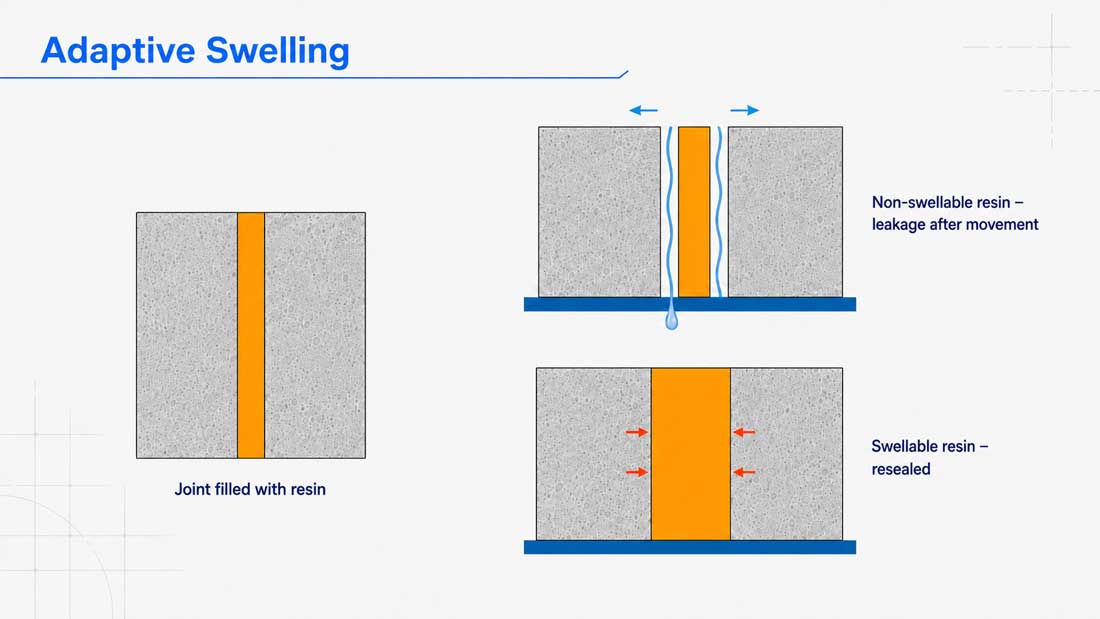
This is precisely where adaptive swelling comes into play. An adaptively swellable injection resin does not remain passive after curing. If it comes into contact with water again, it increases its volume in a controlled manner and can thereby reseal newly formed, small water paths.
This is neither a magical effect nor unlimited “self-healing”. It is the result of purposefully engineered material chemistry.
What Is Adaptive Swelling?
“Adaptive” means that a material can respond to changing environmental conditions. In an adaptively swellable injection resin, water is the triggering factor.
The process can be simplified into four steps:
- The liquid resin is injected into a crack, joint or void.
- It reacts and forms a homogeneous, elastic injection body.
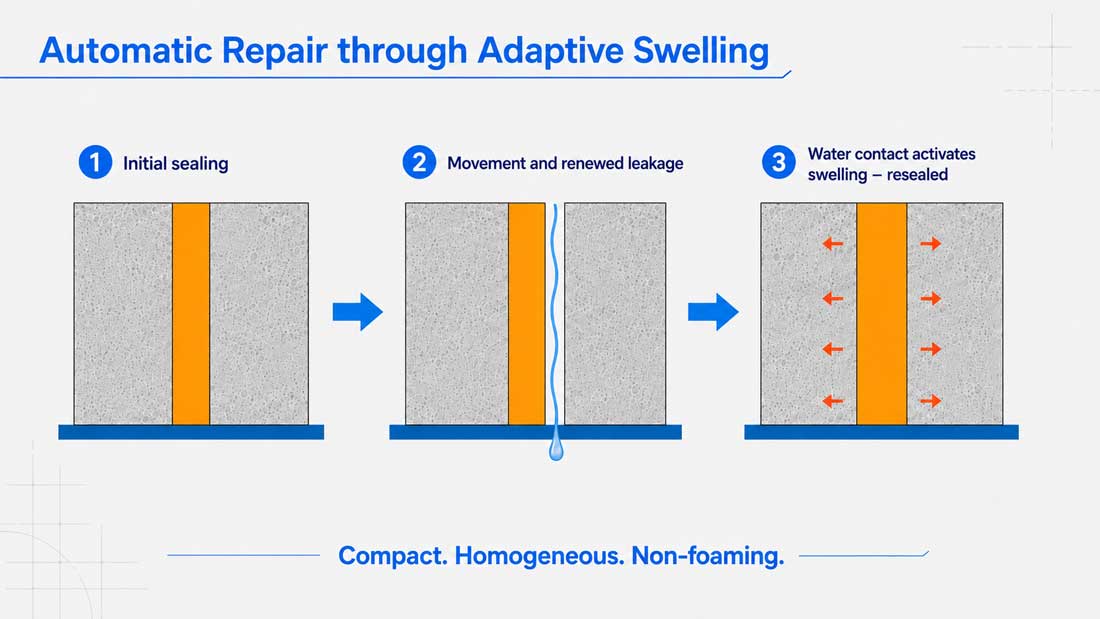
- If the fully cured material comes into contact with water again at a later stage, its volume increases in a controlled manner.
- When the moisture level decreases again, the swelling recedes towards the original cured volume.
This process is reversible and repeatable. When exposed to water again, the material can swell again. It therefore does not react only once during curing but remains water-active throughout its service life.
Why Is This Property So Important for Structural Waterproofing?
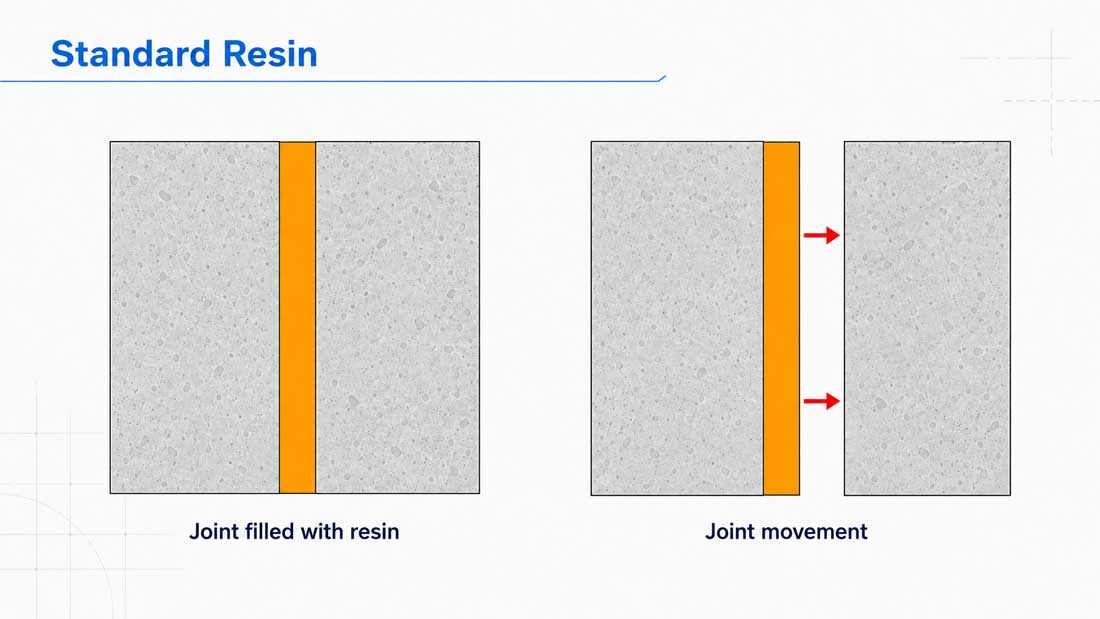
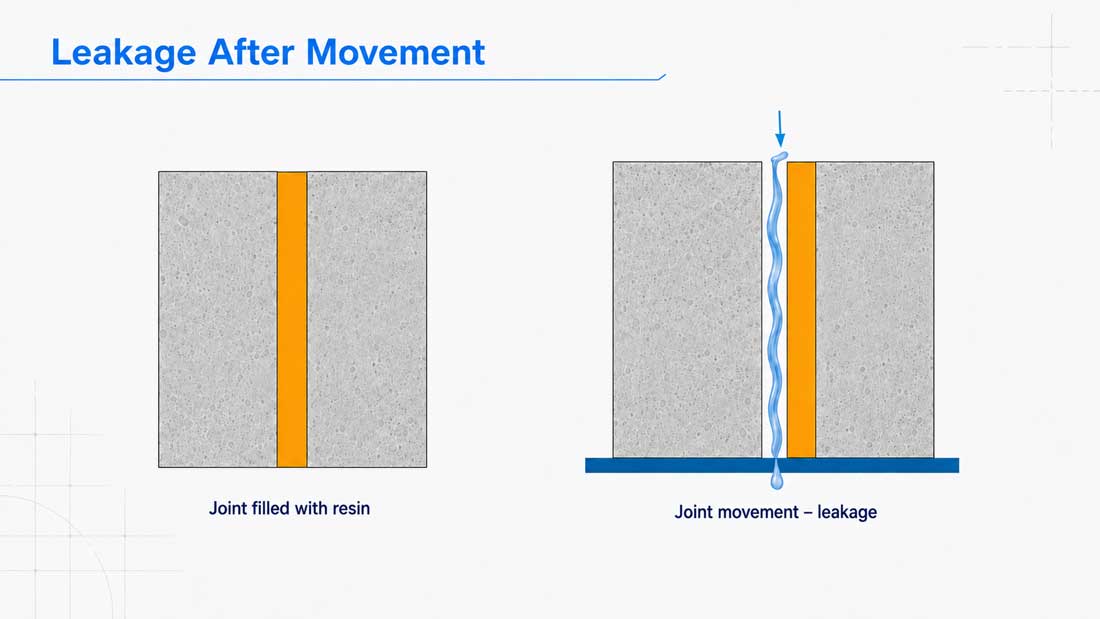
A conventional rigid injection resin may initially fill a crack completely. However, if the structural component subsequently moves, new, fine separations may form between the resin and the crack faces. Renewed cracking can also occur within an injection body that is too rigid.
Elastic resins can accommodate movement more effectively. Their elongation capacity, however, is not unlimited. If the crack cross-section changes or a small new water path forms, elasticity alone may not always be sufficient to restore or maintain a watertight seal permanently.
Adaptive swelling complements elasticity with an active response: if water penetrates a newly formed imperfection, it activates the material’s swelling capacity. The injection body locally increases in volume and exerts controlled contact pressure against the surrounding surfaces. This can reseal small water-bearing paths.
The material therefore reacts exactly where water is present—and exactly when this response is needed.
Swelling Is Not Foaming
The terms “swelling” and “foaming” are frequently confused in practice. Technically, however, they describe two fundamentally different processes.
Foaming
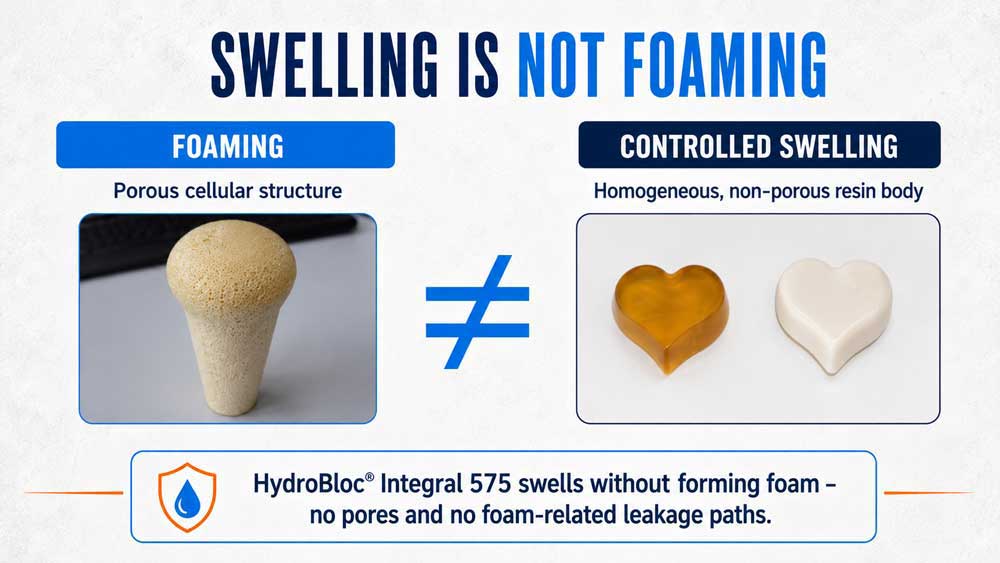
During foaming, gas is generated as part of the chemical reaction. This gas forms cells and pores within the material. The volume increases considerably, while a more or less open- or closed-cell foam structure develops.
PU foams are particularly valuable for stopping water quickly. Their expansion, however, occurs primarily during the reaction and curing process. Once the foam has fully cured, this initial expansion process cannot be repeated.
Swelling
Swelling does not generate gas or create a foam structure. Upon contact with water, the already cured material increases its volume in a controlled manner. It remains homogeneous and non-porous throughout the process.
This distinction is relevant to durability:
- Foam has a cellular structure.
- A swellable injection body remains homogeneous.
- Foaming is primarily a process that occurs during the reaction.
- Adaptive swelling is reactivated by subsequent contact with water.
- The swelling process is reversible and repeatable.
We offer several adaptively swellable injection resins. Here, we explain the effect using the one-component resin HydroBloc® Integral 575 as an example.
HydroBloc® Integral 575 does not foam upon contact with water. Once cured, it forms an elastic, homogeneous and non-porous resin body that can swell in a controlled manner when it comes into contact with water again.
Up to 120% Swelling After Curing
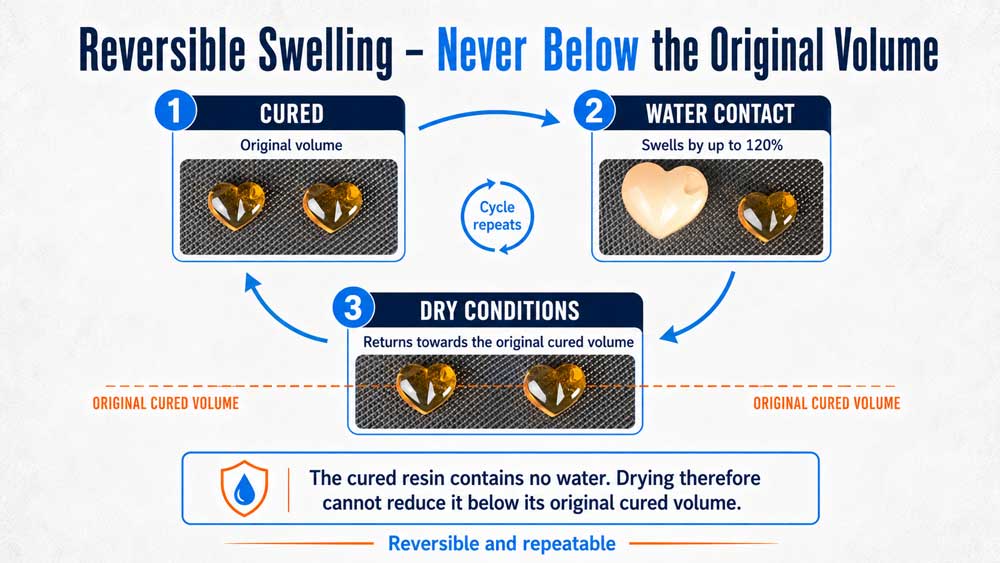
HydroBloc® Integral 575 can increase in volume by up to 120% after 72 hours of contact with water. The timing is crucial: swelling occurs in the material only after it has fully cured.
This effect can be clearly demonstrated in comparative tests. Two identical, cured samples initially have the same volume. One sample is then exposed to water, while the other remains unchanged as a reference. After 72 hours, the water-exposed sample shows a significant increase in volume without forming a porous foam structure.
The figure “up to 120%” does not describe uncontrolled expansion. The swelling that can actually be achieved depends, among other factors, on water availability, temperature, the geometry of the injection space and the surrounding resistance. Within the structural component, the crack faces limit free volume expansion. This enables the material to develop controlled contact pressure within the area being sealed.
Reversible—but Never Smaller Than the Original Volume
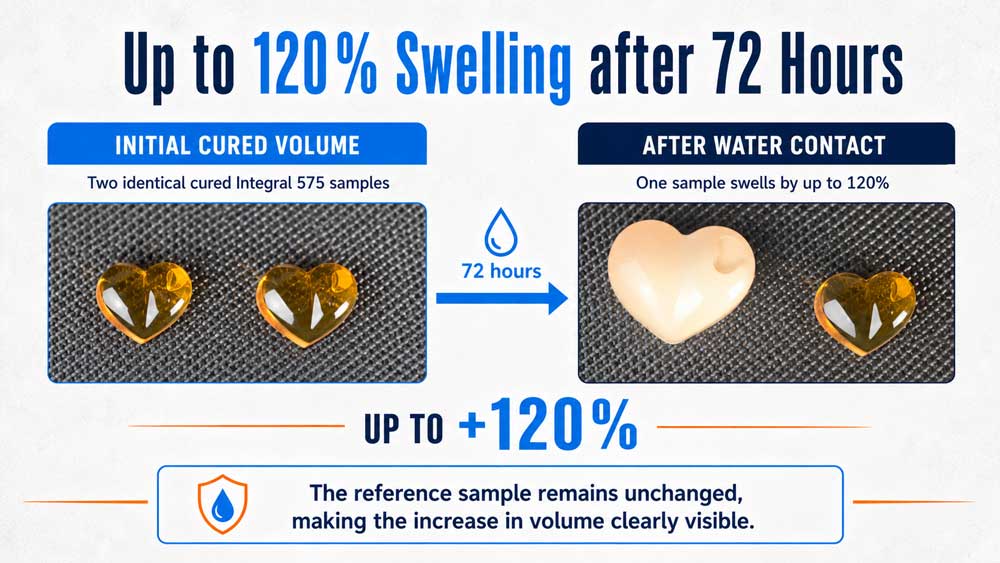
When water exposure decreases, the swelling also subsides. The material returns towards its original cured volume. This process is reversible: when it comes into contact with water again, the resin can swell again.
One important point must be noted: the cured resin itself contains no water. The additional swelling triggered by contact with water can subside during drying, but the material does not shrink below its original cured volume. This is the essential difference compared with gels: gels contain water and can shrink below their initial level under dry conditions. For this reason, gels are not recommended for joints or cracks that are not permanently moist.
In simple terms:
- The starting point is the fully cured injection body.
- Contact with water activates the additional increase in volume.
- During drying, the material returns towards its original volume.
- It does not fall below its original cured volume.
- When contact with water occurs again, the swelling process begins again.
This repeatability distinguishes adaptively swellable resins from materials whose expansion occurs exclusively during a single chemical reaction.
The Self-Healing Effect—a Helpful Term That Requires Explanation
Adaptive swelling is often referred to as a “self-healing effect”. The term illustrates how the process works, but it should be interpreted correctly from a technical perspective.
The self-healing effect relates exclusively to the waterproofing function: if minor movements create new water-bearing paths, the ingress of water can reactivate the swelling process. The material increases its volume, thereby helping to reseal these fine paths.
A more precise term would therefore be a “water-activated, reversible resealing effect”.
Conclusion: Waterproofing That Can Respond to Water
Adaptive swelling adds an active, water-dependent function to conventional elastic crack sealing. The cured resin remains homogeneous and non-porous. When it comes into contact with water again, its volume increases in a controlled manner, enabling it to reseal small, newly formed water paths.
The swelling process is reversible and repeatable. During drying, the material returns towards its original cured volume without falling below it. The waterproofing system therefore responds not only during application but also to changing moisture conditions within the structure at a later stage.
HydroBloc® Integral 575 combines this adaptive swelling effect with a non-foaming, elastic, one-component PU injection resin. This makes it a versatile solution for cracks, construction joints, honeycombs, injection hoses and many other common waterproofing tasks.
Adaptive Swelling Explained in Our Video
Our video explains what adaptive swelling means and why adaptive, swellable resins represent an important advance in reliable structural waterproofing:
Why These Resins Are Essential for Reliable Waterproofing—Watch the Video
Would You Like to Know Whether an Adaptively Swellable Resin Is Suitable for Your Project?
ARCAN can support you in assessing the cause of the damage, selecting the appropriate injection material and developing a project-specific waterproofing concept. Send us information about the structural component, the type of leakage, the existing water exposure and any potential movement.
Together, we will develop a technically appropriate and permanently effective solution.
Further information: www.arcan.biz